
FACING THE CHALLENGES OF SUSTAINABILITY
Globally, the fashion industry is responsible for 10% of greenhouse gas emissions.
The textile industry is the second most polluting industry on the planet, contributing 20% of the world’s wastewater.
Sorting, collecting and recycling used or unsold clothing is a very complicated task, due to the many blends of man-made and natural fibers used in today’s garments. Today, there is no technology to solve this problem, and most textile waste ends up in landfills.
What is NERIDE BIODEGRADABLE?
NUREL proposes a solution for nylon textiles that end their useful life in landfills.
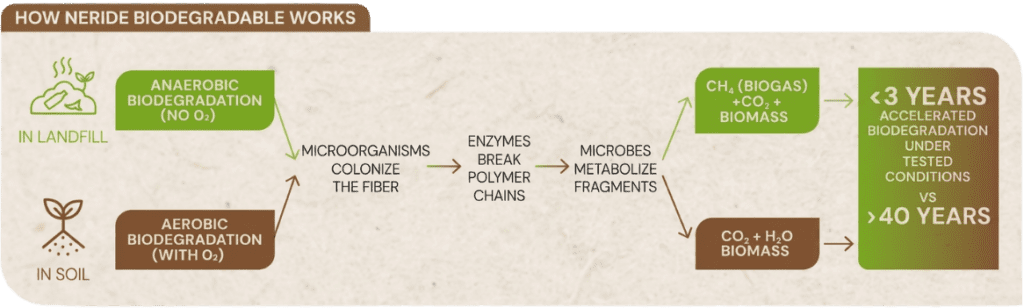
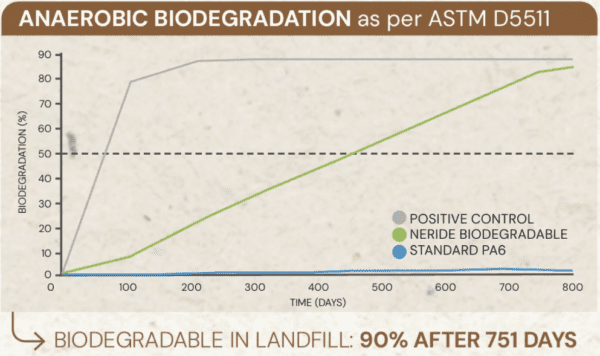
Thus, NERIDE BIODEGRADABLE is a nylon 6 yarn that biodegrades at the end of its life cycle, transforming into biomass and methane which, when properly captured, becomes green energy.
NERIDE BIODEGRADABLE biodegrades in both aerobic and anaerobic* environments.
Unlike other fibers, NERIDE BIODEGRADABLE is not decomposed by oxygen or UV rays, as it is not oxo-degradable. In addition, NERIDE BIODEGRADABLE maintains the physical properties and shelf life of PA6 and only degrades when it comes into contact with an active biological environment. It is processed by standard PA6 production methods.
NERIDE Biodegradable is an innovative PA6 designed to enhance biodegradation in soil and landfill environments while maintaining the performance of conventional nylon
Biodegradable properties
- MAINTAIN RECYCLABILITY: compatible with PA6 recycling streams
- COMPATIBLE WITH BIODEGRADABLE ELASTANE: enables greater biodegradability in stretch fabrics
- IMPROVES END-OF-LIFE MANAGEMENT: suitable for textiles that are difficult to recycle and complex blends
- COMPATIBILITY WITH NATURAL FIBRES: biodegrades alongside natural fibres such as cotton or wool in blends
- NO IMPACT ON PERFORMANCE DURING USE: biodegradation is only activated in specific microbial environments
- REDUCES THE PERSISTENCE OF MICROPLASTICS: is assimilated by microorganisms, preventing the long-term persistence of microplastics
Aerobic and anaerobic biodegradation
NERIDE BIO's carbon footprint impact
- The end-of-life of any material is fundamental to the calculation of the carbon footprint, which implies that it must be analyzed according to each disposal scenario.
- The largest reduction in NERIDE BIO’s carbon footprint is obtained by managing its waste in landfills, where the resulting methane is managed and converted into green energy, providing approximately a 15% carbon reduction.
NERIDE BIO's carbon footprint impact
- The end-of-life of any material is fundamental to the calculation of the carbon footprint, which implies that it must be analyzed according to each disposal scenario.
- The largest reduction in NERIDE BIO’s carbon footprint is obtained by managing its waste in landfills, where the resulting methane is managed and converted into green energy, providing approximately a 15% carbon reduction.
What is NERIDE® BIO?
NUREL proposes a solution for nylon textiles that end their useful life in landfills.
Thus, NERIDE BIO is a nylon 6 yarn that biodegrades at the end of its life cycle, transforming into biomass and methane which, when properly captured, becomes green energy.
NERIDE BIO biodegrades in both aerobic and anaerobic* environments.
Unlike other fibers, NERIDE BIO is not decomposed by oxygen or UV rays, as it is not oxo-degradable. In addition, NERIDE BIO maintains the physical properties and shelf life of PA6 and only degrades when it comes into contact with an active biological environment. It is processed by standard PA6 production methods.
Aerobic biodegradation
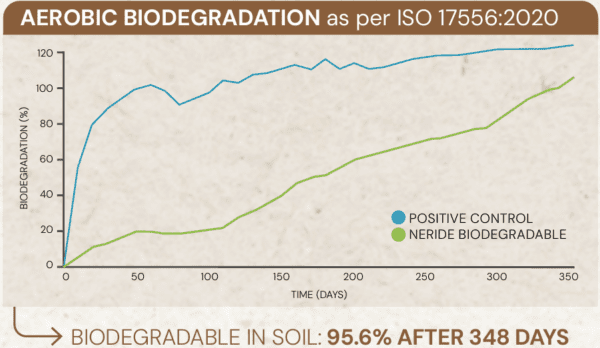
- In case of improper disposal of textile waste, NERIDE BIO will also biodegrade in the soil.
- Aerobic biodegradation is the degradation of organic matter by microorganisms in oxygen containing environments such as soil.
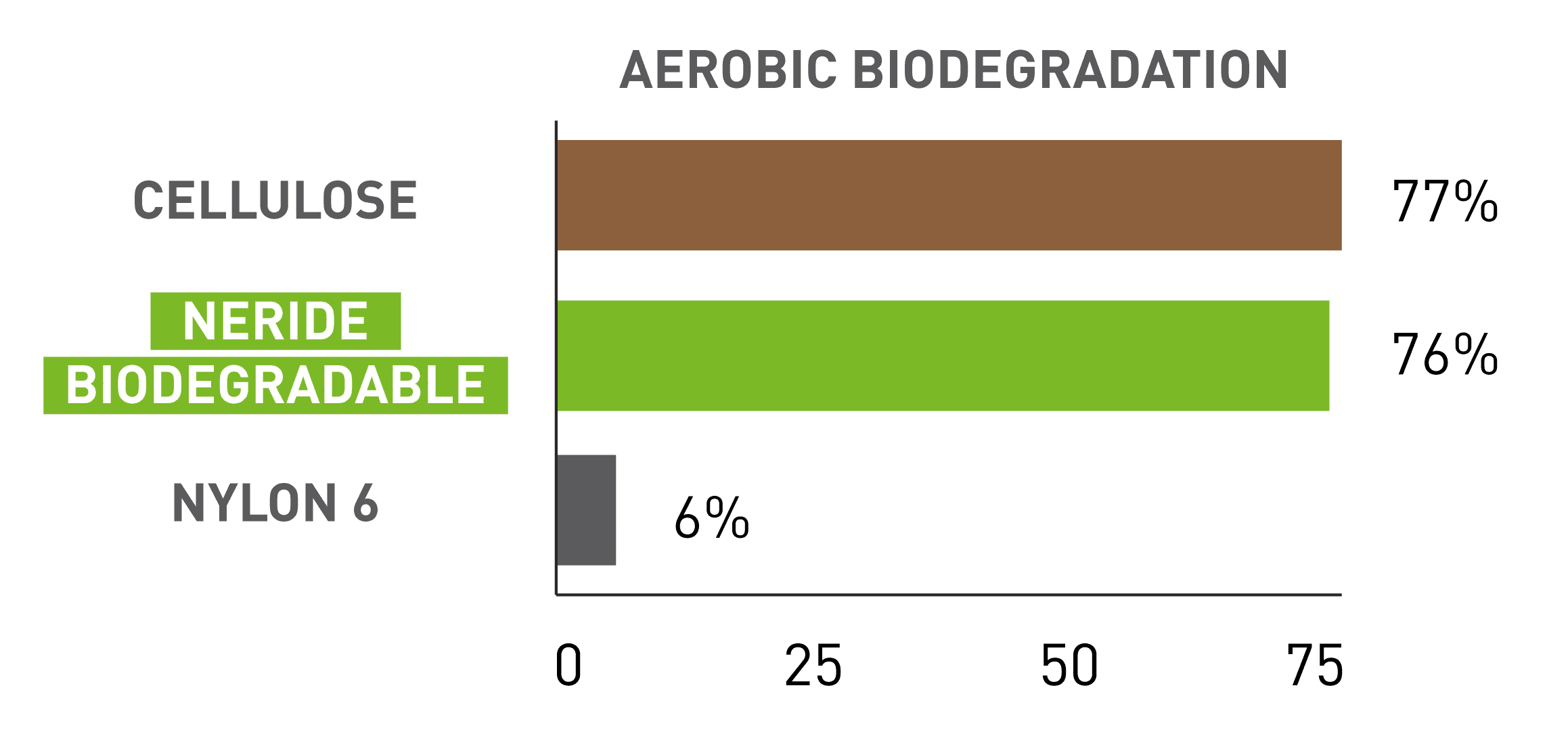
- The aerobic certification of NERIDE BIO, according to ISO 17556:2012, establishes a biodegradation of 76% after 90 days in active soil similar to that of cellulose fibers.
- Under the same conditions, NERIDE BIO biodegrades at the same rate as cellulose.