



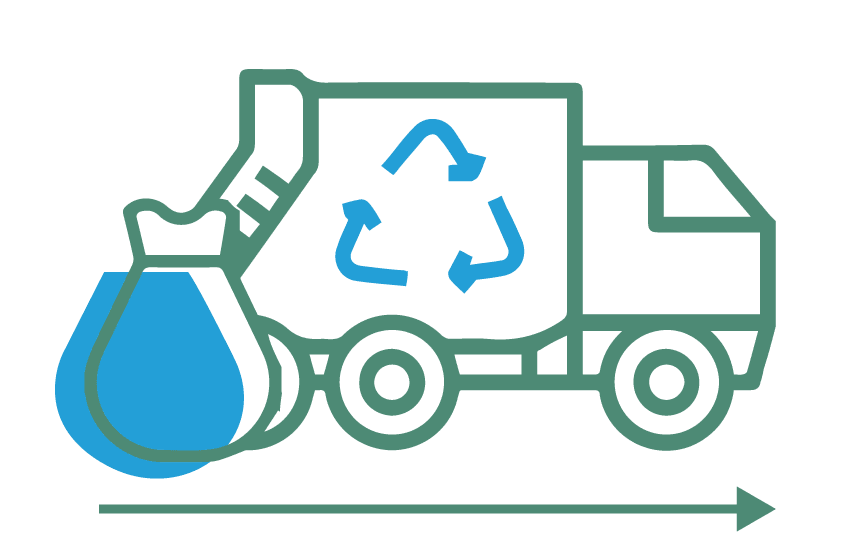
Anaerobic biodegradation occurs in oxygen-deprived environments, such as landfills, designed to reduce greenhouse gas emissions and convert them into green energy.

Promyde BIO promotes biofilm formation. Biofilm is a bacterial colony and its growth generates the enzymes necessary for polyamide metabolization.

These enzymes break down polyamide into biomass and biogas (methane).

PA is converted to methane, while reducing landfill waste volume and generating green energy (RNG/LFG).



1. What are the main properties of Promyde BIO?

Promyde BIO retains the same physical properties and strength as standard grades of Promyde. Your products will retain an indefinite shelf life, unaffected by light, heat, moisture or stress, until they are disposed of in an environment with microbial activity (such as landfills or active soils) where they will biodegrade into biomass, CO₂ and biogas.
2. How does Promyde BIO compare to other polymers?
| Product | Degradation by light, heat, moisture or mechanical stress | Biodegradation in landfills (anaerobic) | Soil biodegradation (aerobic) | Residues |
|---|---|---|---|---|
| Promyde BIO | No | 1–15 years | 1–10 years | Biomass, CO₂, Biogas |
| Conventional polymers | No | > 100 years | > 100 years | Plastic resin |
| Compostable polymers | Yes | 1–15 years | 1–10 years | CO₂, Biogas |
| Oxodegradable polymers | Yes | > 100 years | > 100 years | Microplastics, metal ions, heavy metals |
3. What is the difference between biodegradable, compostable and degradable plastics?

- Biodegradable plastic: degrades through the action of microorganisms in aerobic (with oxygen) or anaerobic (without oxygen) environments, within an unspecified period of time.
- Compostable plastic: decomposes under composting conditions into CO₂, water, inorganic compounds and biomass, complying with standards such as EN13432, within a specific period.
- Degradable plastic: undergoes chemical changes under environmental conditions that deteriorate its physical properties, usually initiated by oxygen, UV light, or heat. They begin to degrade from the moment they are manufactured, reducing their useful life. Oxo-degradable polymers are banned in Europe.
4. Do traditional plastics biodegrade, and how does Promyde BIO do so?

Traditional plastics are durable and not designed to biodegrade easily. Their structure is based on long chains of carbon atoms that provide strength and durability, but make it difficult for microorganisms to metabolise them.
5. 5. How does Promyde BIO biodegrade?
Promyde BIO accelerates biodegradation thanks to its advanced technology, which promotes the accumulation of microorganisms and facilitates the acclimatisation and production of enzymes that enable their metabolisation.
6 Does Promyde BIO biodegrade while in storage?
No. Promyde BIO requires an active microbial environment (such as a landfill or biologically active soil) to biodegrade.
It does not degrade in warehouses, offices, or on shelves.
7. How long does it take for Promyde BIO to biodegrade?

The biodegradation time depends on factors such as surface area, mass, thickness, and environmental conditions.
Under optimised conditions:
- Up to 24.7% biodegradation in 160 days under anaerobic conditions.
- Up to 95.6% biodegradation in 348 days in active soil.
8. What tests validate the biodegradation of plastics in a landfill?

Laboratories use standardised tests such as:
- ASTM D5511 → short-term biodegradability.
- ASTM D5526 → long-term simulation of landfill conditions.
Each trial has a different approach and limitations, so their results should not be directly compared.
9. Can Promyde BIO be used in food contact applications?

Yes. If Promyde’s standard grade complies with FDA and EU regulations for food contact, Promyde BIO will also be suitable.
10. What does the ISO 17556 standard consist of?
ISO 17556 defines the methodology for testing the biodegradation of materials in soil.
- The material is preferably used in powder form, although it can also be used in film, fragment, chip or profile form.
- 100–300 g of material is used, with a maximum size of 5×5 mm.
- To compare different polymers, it is recommended to use the same format.
- The greater the contact surface area of the material, the higher the rate of biodegradation.
11. In which applications is Promyde BIO the ideal material?
Promyde BIO is designed for applications with high technical requirements where compostable polymers are not sufficient.
Particularly suitable for:
- Short-life applications.
- End-of-life parts that are not recycled effectively or disposed of properly.

